
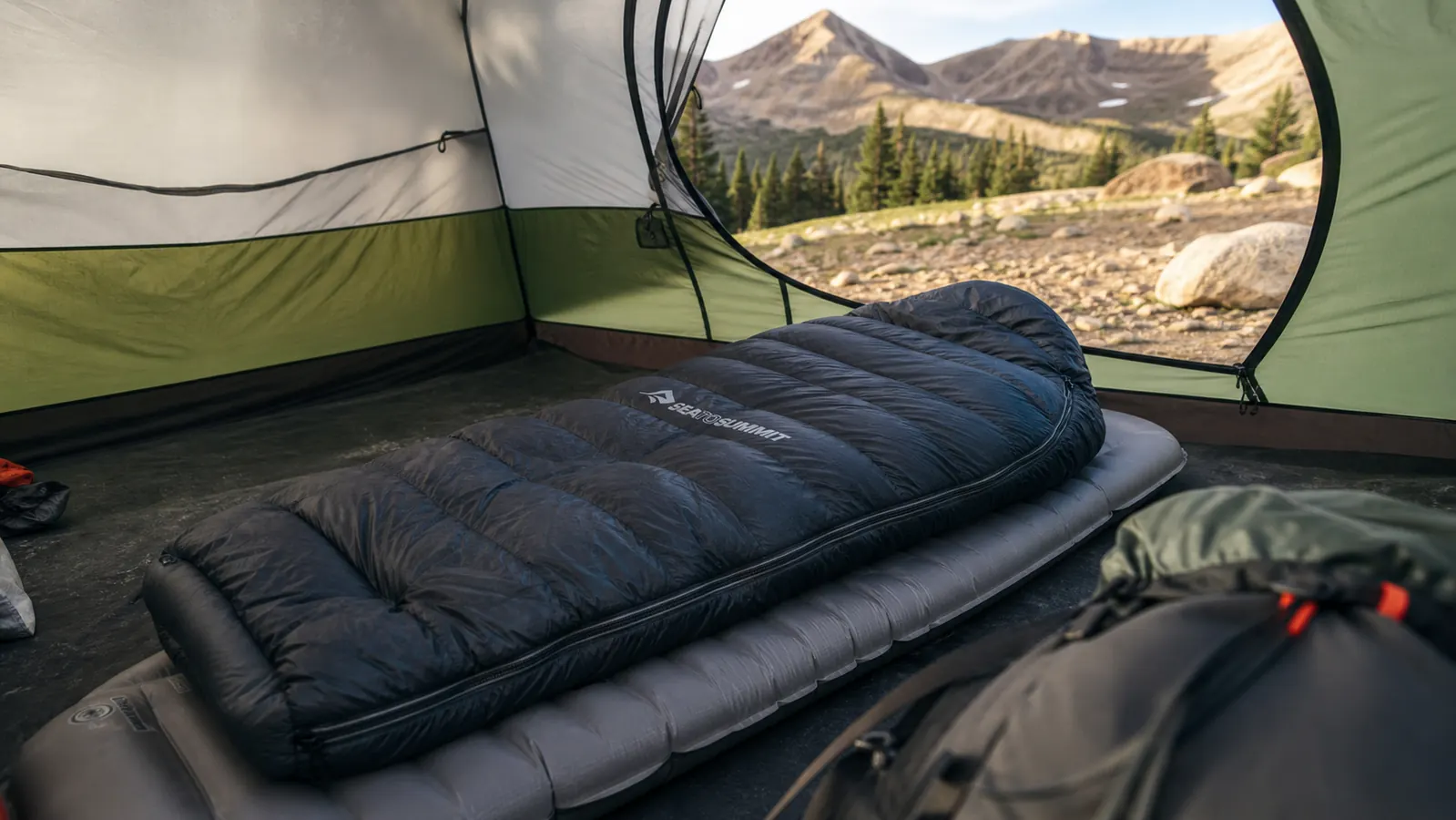
Here is what nobody on Amazon is going to tell you about the TETON Sports TrailHead sleeping bag: the 20-degree rating printed on the stuff sack is technically accurate and practically misleading at the same time. I've had this bag out on more than a dozen trips around Colorado, and I want to give you the real picture before you click buy based on a 4.5-star average and 1,735 reviews that mostly say 'great for the price.' Because great for the price and great for YOUR trip are two different things, and the difference matters a lot when the temperature at your campsite drops.
This is not a takedown of the TrailHead. It earns its place in the budget mummy bag category and I've recommended it to plenty of people. But I've also watched friends haul it on trips where it was genuinely the wrong tool, and I've fielded enough questions about it that I want to write the review I wish existed before I bought mine: one that gives you the surprises alongside the strengths.
The Quick Verdict
A solid car-camping and mild-season backpacking bag for adults who sleep warm and don't need it below 30F in practice. Broad-shouldered campers and cold sleepers should size up or look elsewhere.
Amazon Check Today's Price →If the TrailHead fits your conditions, today's price is hard to argue with
Budget mummy bags usually mean compromises. The TETON TrailHead keeps the ones you can work around and avoids the ones that ruin a trip. Check current pricing and availability on Amazon before you decide.
Amazon Check Today's Price on Amazon →What the Rating System Actually Means (And Why It Trips People Up)
The TrailHead is rated to 20 degrees Fahrenheit. What most buyers don't realize is that temperature ratings on sleeping bags in this price range follow the EN 13537 standard loosely at best. At this price point, TETON uses an internal test standard, which means the 20F claim is not independently verified the way a premium bag from REI or Big Agnes would be. The company says the rating reflects 'survival' temperature for an average adult male. That is a survival floor, not a comfort floor.
In practice, I found the TrailHead comfortable down to about 32 to 34 degrees Fahrenheit with a base layer on and a sleeping pad underneath. Below that, you feel it. By 25F I was wearing a fleece mid-layer inside the bag, which works, but it's a workaround. If your planned campsite regularly drops into the low 20s, this bag is not your 'one bag for everything.' It's a three-season bag with a stretch rating, not a true winter bag.
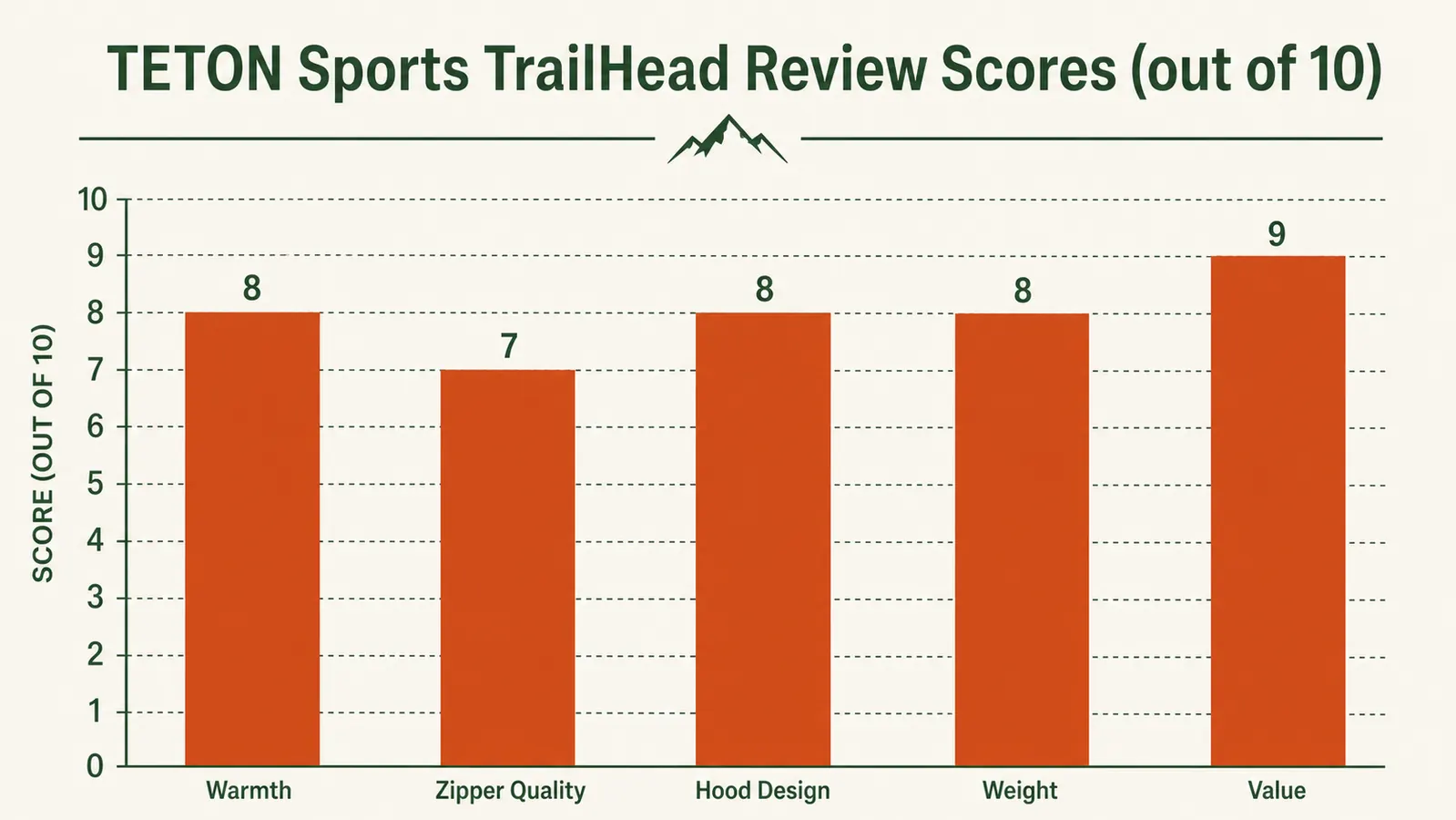
Where this matters most: if you're camping in the Colorado mountains in September or October, those nights can drop to 25F without warning. I've been there. The bag handles it, but not comfortably. Plan accordingly, layer up, and know that the bag's real sweet spot is roughly 35 to 50 degrees, which covers the majority of spring, summer, and early fall camping at most elevations.
The Zipper: What Reviewers Gloss Over
The TrailHead uses a YKK-style zipper that runs the full length of the right side and up around the hood. The zipper itself is fine. The issue is the draft tube, which is the fabric flap that's supposed to prevent cold air from seeping in along the zipper track. On my bag and on several other TrailHeads I've handled, the draft tube is narrow enough that if you shift position during the night, especially rolling to your right side, the zipper track can separate slightly from the draft tube and let a thin line of cold air in. It's not a gap you'd notice at 50 degrees, but at 30F it wakes you up.
The fix is simple: before you zip up for the night, tuck the draft tube over the zipper manually instead of letting it fall where it lands. Takes three seconds and solves the problem. But I want you to know about it before you're at 11,500 feet on your first cold night wondering what that draft is. This is the kind of thing no Amazon review mentions because most people buy this bag for summer use where it never comes up.
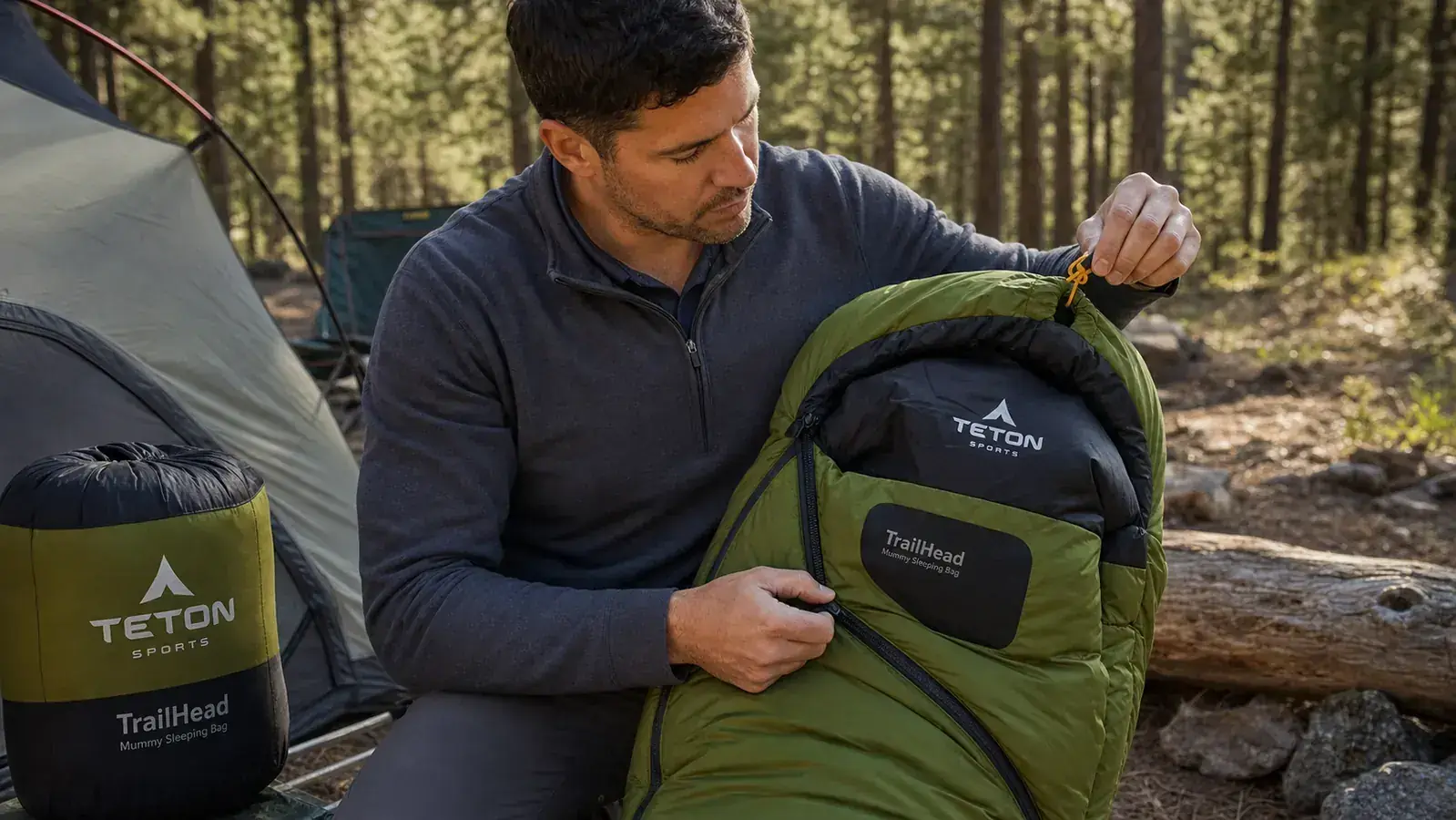
Tuck the draft tube over the zipper manually before you zip up. Takes three seconds. At 30F it's the difference between a good night and a cold one.
Fit and Who It Actually Works For
The TrailHead comes in regular and long versions. The regular fits adults up to about 6 feet, the long fits up to 6 foot 2 or so. I'm 5 foot 11, 185 pounds, and the regular fits me well from a length standpoint. However, I have broad shoulders and a bigger chest, and I noticed right away that the mummy taper from shoulder to hip is cut fairly narrow through the torso. I can roll over but it takes effort. My buddy who is 6 foot even and 175 pounds with a narrower build finds the same bag unrestricted.
If you're above 200 pounds or have a wider build through the shoulders, I'd push you to look at the TETON Sports Celsius bag or the Kelty Tuck series, both of which cut a more generous mummy taper. The TrailHead is designed for a leaner fit to improve insulation efficiency. That's a legitimate design choice, and it works for the right body type. It's just not always disclosed clearly in the listing.
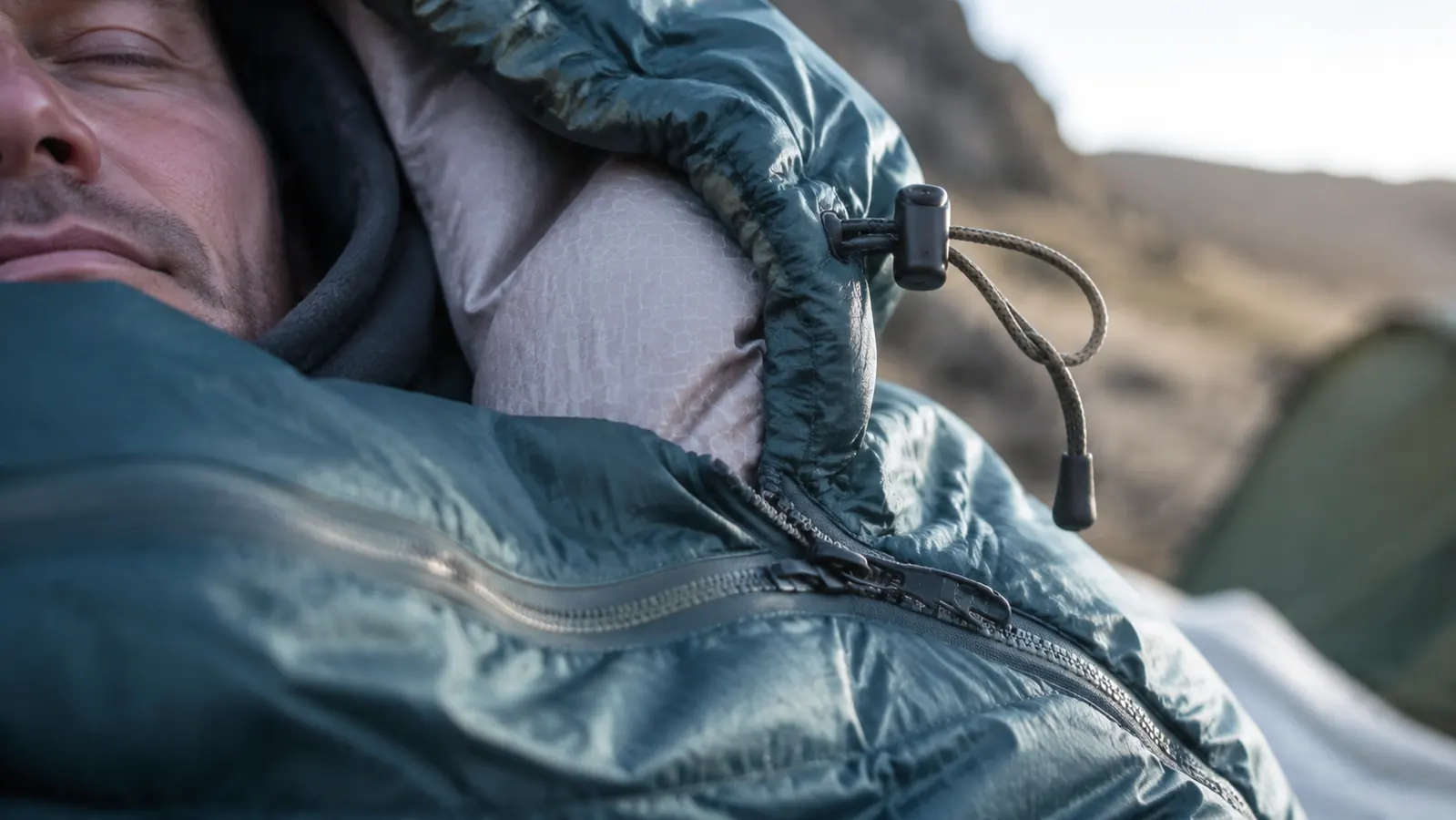
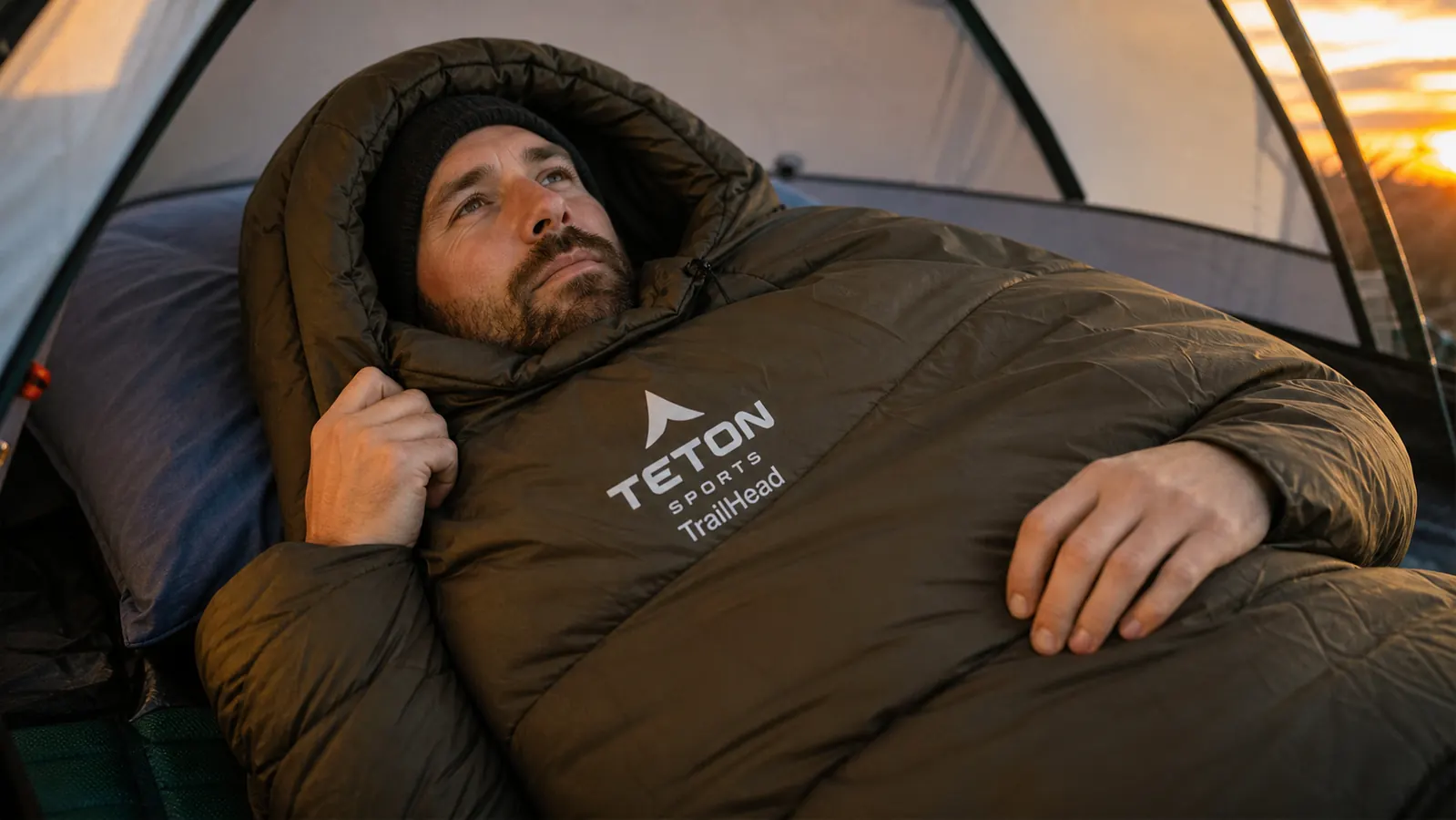
The hood is worth calling out as a genuine strength. It cinches down tight with two drawcords, one for the opening diameter and one for the general hood shape. When it's cold, you can pull it almost completely closed and leave just your nose and mouth exposed. For a bag in this price range, the hood design is legitimately better than what you get on competing bags from Teton or Coleman at a similar price.
The Shell and Fill: What You're Actually Getting
The TrailHead uses a polyester taffeta shell and a synthetic fill that TETON calls 'SuperLoft Elite.' I want to be straight with you: SuperLoft Elite is a brand name for a standard polyester fiber fill, similar to what you'd find in any budget bag. It is not comparable to goose down or high-end synthetic fills like PrimaLoft or Climashield. What that means practically is that the bag compresses to a moderate size, not ultralight, and it will absorb some moisture in a humid environment rather than shedding it.
For car camping this is irrelevant. You're not counting ounces in a car, and the bag will air out between uses. For backpacking, it matters more. The TrailHead packs down to roughly the size of a large cantaloupe in its compression sack. That's fine for weekend trips where you're not trying to fit everything in a 40-liter pack. If you're ultralight-focused or doing multi-night trips above treeline, you'll want something with more compressibility.
The liner fabric is brushed polyester, and this is where the bag earns some of its budget-friendly reputation honestly. It's genuinely soft. I've used bags in this price range that feel scratchy against bare skin, and the TrailHead is not that. Whether you're camping in shorts or a full base layer, the liner doesn't create friction or discomfort. That sounds minor but it makes a real difference over eight hours of sleep.
What Happens After 20 or 30 Uses
Synthetic insulation compresses over time. That's not a flaw specific to TETON, it's a property of polyester fill. After about 25 to 30 nights in the bag, I noticed the insulation loft had reduced slightly compared to when the bag was new, especially along the back panel where you're sleeping on it. This is normal, and washing the bag on low heat in a front-load machine with a specialized down cleaner like Nikwax Tech Wash helps restore some loft. But it's worth knowing that a synthetic bag like the TrailHead will degrade faster than a comparable down bag over the same number of uses.
If you camp two weekends a month from April through October, you're looking at roughly 15 to 20 nights of use per season. The TrailHead will hold up well for two to three full seasons of that use before you start to notice any meaningful degradation in insulation performance. At the current price point, that math still works in the bag's favor compared to buying a premium synthetic bag.
What I Liked
- Soft brushed liner that's comfortable against bare skin, even in warmer temps
- Hood cinches down tight with two drawcords, better design than most budget competitors
- Available in regular and long sizes to accommodate most adult heights
- Machine washable in a front-load washer, easy to maintain
- Compression sack included and functional for weekend backpacking
- Price-to-warmth ratio is strong for three-season car camping and mild backpacking
Where It Falls Short
- Real comfort floor is closer to 32-34F despite the 20F rating on the packaging
- Draft tube on the zipper requires manual adjustment to seal properly in cold temps
- Cut runs narrow through the shoulders and chest, restrictive for wider builds
- Synthetic fill loses loft faster than down over time with repeated compression
- Not a true ultralight option for pack-weight-conscious backpackers
- Fill absorbs moisture in humid conditions, slower to dry than down
Alternatives Worth Knowing About
The most direct competitor in this price range is the Coleman Sleeping Bag line, specifically the Coleman Green Valley Cool Weather bag and the Coleman North Rim 0F bag. The North Rim is actually cheaper most of the time and has a more generous cut through the torso, which makes it the better pick if you run wide or tend to move around a lot in your sleep. The tradeoff is that the North Rim's hood is less structured than the TrailHead's, and the liner fabric is stiffer. For most people who are not dealing with a narrow mummy fit issue, the TrailHead wins on build quality. For bigger-framed campers, I'd seriously look at the Coleman comparison first.
If you want to read a deeper side-by-side breakdown, I put together a full TETON TrailHead vs Coleman comparison that goes through price, weight, cut, and real-world warmth. And if you're trying to solve the 'what do I wear to sleep' question to get more out of any bag you own, the guide on staying warm camping in cold weather covers the layering system I actually use.
Who This Is For
The TrailHead is a strong buy for adult campers with a medium build who primarily camp in spring through fall, with nighttime temps that stay at or above 32 degrees. It's especially good for car campers who want something more packable and shaped than a rectangular bag without spending three figures on a premium mummy. If you're buying for a first camping trip, a summer festival, or occasional shoulder-season weekend trips, this bag covers those use cases well and then some. It's also a reasonable choice for older teens and adults who are new to mummy bags and want to try the format without a big investment.
Who Should Skip It
If your camping trips routinely drop below 25F, or if you run cold by nature, pay the extra money and get a bag that's genuinely rated to the temperature you need. The same applies if you have a stockier build with wide shoulders. You'll spend too many nights half-wrestling the bag to make it work. Backpackers chasing sub-5-pound base weights will also want to look elsewhere. And if you're planning any camping in wet coastal environments or Pacific Northwest conditions where humidity and condensation are constants, a synthetic bag that holds moisture is going to give you problems that a bag with a water-resistant shell treatment would handle better.
Know what you're buying and it'll be one of the best budget decisions you make for camp
The TETON TrailHead punches above its price in the conditions it's built for. If your trips match the three-season, mild-to-moderate cold profile, check today's price and read the sizing notes in the listing before you order.
Amazon Check Today's Price on Amazon →