
Before my last trip up to Eleven Mile Canyon, my buddy Drew sent me a screenshot of the Favourlite camping lantern with a simple text: "3000 lumens for cheap, this has to be garbage, right?" I told him I'd already been using one for about eight months and that the real answer was more complicated than garbage or great. He bought it anyway. When we were back at camp that first night, he pulled it out, cranked it to full brightness, and said "okay this is insane." Then it died three hours later and we were eating dinner in the dark. That's the Favourlite experience in a nutshell, and it's almost exactly what the 1,500 Amazon reviews will not tell you.
The reviews aren't wrong. They just describe the lantern in ideal conditions, for short durations, from people who haven't pushed on the edges. I've taken this thing on nine camping trips now, ranging from one-nighters at a car campsite to a four-day trip at a dispersed site with no power. I know where it works well, where it quietly disappoints, and two specific situations where it'll leave you in the dark. That's what this review is about.
The Quick Verdict
A genuinely solid compact lantern that earns its rating, but only if you understand it runs out of steam at max brightness in under three hours, and the phone-charging feature is emergency-only, not a power bank substitute.
Amazon Check Today's Price →If you want to skip straight to buying: the Favourlite is worth it at this price, but read the runtime section first.
Rated 4.4 stars from 1,500+ campers. At the current price, it's one of the better-value rechargeable lanterns available. Just set your expectations right.
Amazon Check Today's Price on Amazon →The Lumen Claim: What "3000 Lumens" Actually Means in Practice
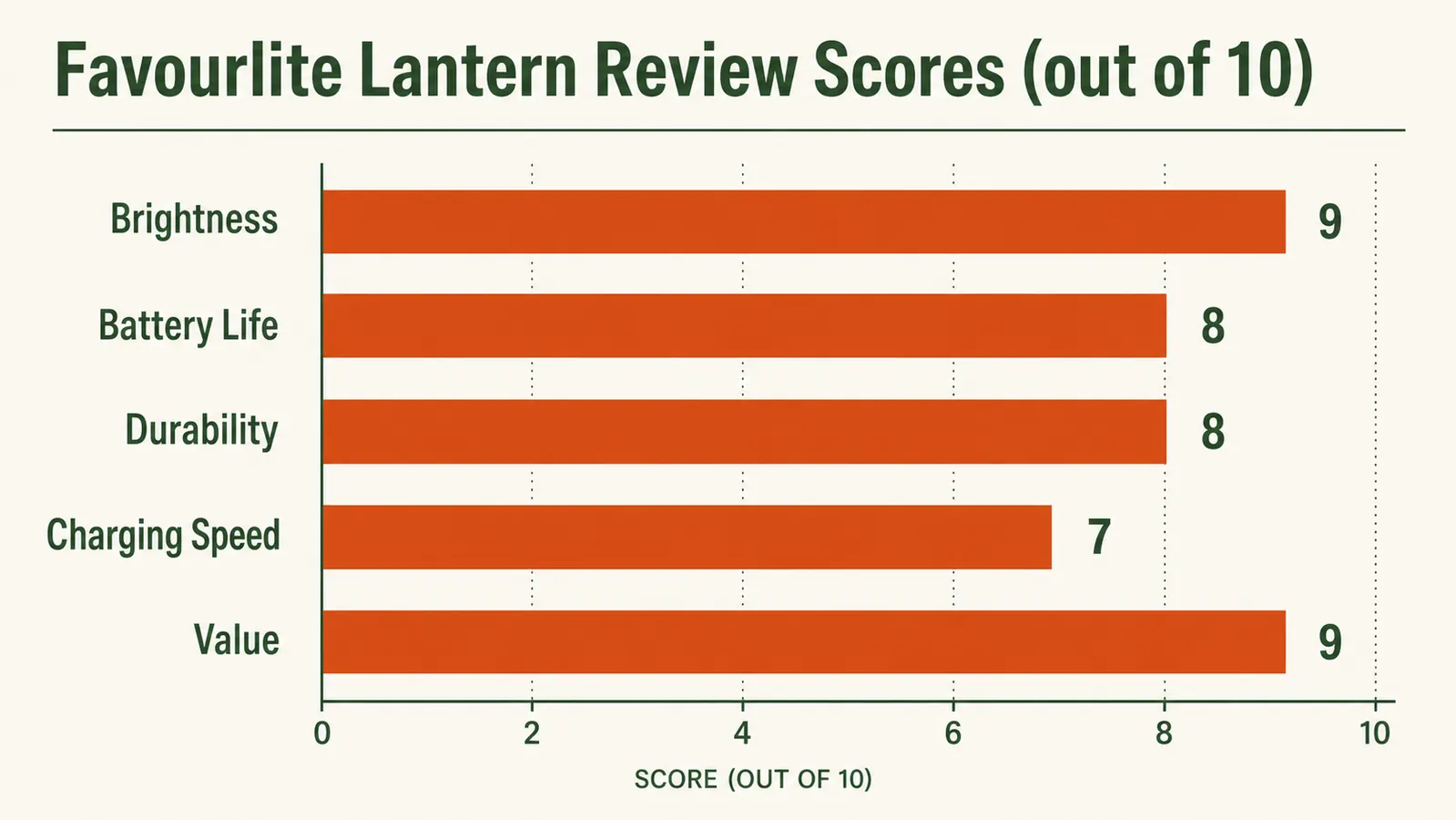
Let's start here because this is the single thing the Amazon reviews get wrong most often. Yes, the Favourlite puts out 3000 lumens. For about the first 20 minutes. After that, the output steps down as the battery starts depleting, and what you actually live with for the bulk of an evening is somewhere in the 1500-to-1800 lumen range. That's still bright, genuinely bright, enough to light a 10-foot circle around your picnic table without issue. But the 3000-lumen claim is peak performance, not sustained performance.
At max, the battery is gone in two to two-and-a-half hours depending on temperature. Cold nights in the Rockies will shorten that further, not extend it. The sweet spot for this lantern is the medium-high setting, which gives you something in the 1800-lumen range and gets you four to five hours of consistent light. If you're cooking dinner, playing cards, and sitting around talking until 10 PM, that's enough for most outings. But if you forget to charge it before the trip, or you run it wide open all evening thinking you have plenty of time, you will run out of light.
Run the Favourlite on medium-high and you get four to five hours of genuine campsite light. Run it on max and you get a dramatic first hour and a dark second hour. Most reviewers only see the first hour.
The Phone Charger Feature: Useful, With a Catch
The Favourlite has a USB-A output port on the side that lets you charge a phone or other device directly from the lantern's 4400mAh internal battery. This is the feature that gets a lot of excitement in the reviews, and I understand why. For a budget lantern, having a built-in power bank feels like a bonus. But here's what nobody explains: when you use the lantern as a phone charger, you are pulling from the same battery that powers the light. Every 10% you put into your phone is 10% less light you get later.
A full charge on the Favourlite's 4400mAh battery will get a typical smartphone from about 20% to full, once. After that, the lantern battery is depleted enough that runtime drops noticeably. I use the phone charger feature as genuine emergency backup only, when my phone is at 5% and I need to call someone. I don't lean on it as a regular camp power solution. If you're coming in expecting this to function like an Anker 20000mAh battery bank that also lights your campsite, you'll be frustrated. If you think of it as a lantern with a nice emergency phone-charge safety net, it's a satisfying bonus.
Build Quality at This Price Point: The Honest Take
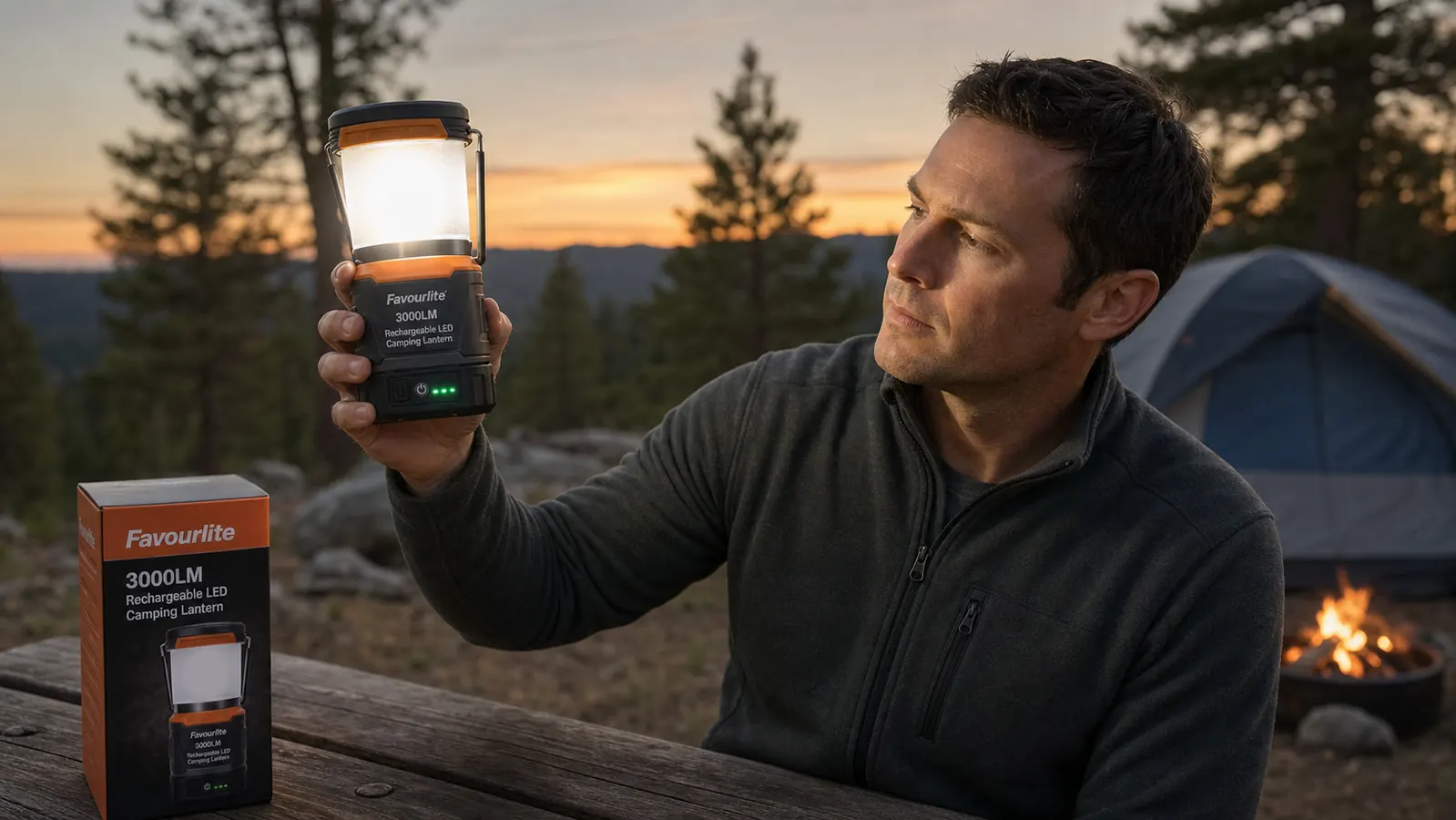
The Favourlite is made of plastic. That's not a knock, that's just what a budget lantern is made of. The question is whether it's good plastic, and the answer is: mostly yes. The shell has some flex to it but I've dropped it from chair height twice with no cracking. The hanging loop at the top is a rubber-coated metal ring, not a flimsy plastic tab, which matters because this is where the lantern takes stress when you hang it from a tent ridgeline or a clothesline. The mode button has a satisfying click and hasn't gotten mushy after nine trips.
The one genuine weakness in the build is the USB-C charging port cover. There's a small rubber plug that keeps water and dust out of the port. On my unit, that plug started pulling loose around the fourth month. It's still attached, but it no longer sits flush. In a light rain, that port cover matters. This isn't a waterproof lantern, it's splash-resistant at best, but a loose port cover makes me more careful about where I set it when there's any moisture around. Worth knowing before you take it somewhere that might see serious rain.
The Five Light Modes: What I Use vs. What Exists
The Favourlite has five modes: high, medium-high, medium, low, and SOS/flash. Cycling through them is a single button press, which works fine when you remember the sequence. The problem is the sequence starts on high every time you power up. So at 3 AM when your kid needs to find the bathroom, you click it on and blast everyone in the tent awake with 3000 lumens. A glow-up mode from low would be a better default. This is a real ergonomic miss and I've seen two other people in my camping group complain about the same thing.
In practice, I use medium-high for dinner and hanging out, low when everyone's in the tent and winding down, and I've never used SOS. The SOS mode cycles between white and red flashing, and it's loud visually, which I suppose is the point. The red-only mode that some lanterns have for preserving night vision is not available here. If you do any stargazing or need to move around camp without wrecking your night vision, that's a gap worth knowing about.
Recharging Time: The Number Nobody Publishes
Nobody in the reviews talks about how long it takes to recharge this thing, and I wish they did. From fully dead to fully charged via USB-C takes between five and six hours. That's a long recharge window. If you drain it on night one of a two-night trip, you'd better have a way to charge it the next day, a portable power station, a car outlet adapter, or a solar panel with enough output, otherwise night two starts with a half-charged lantern at best.
The input is USB-C, which is correct and modern, but the input amperage is limited. A fast charger won't dramatically accelerate the timeline. I've tried a 65W USB-C brick and a standard 5W cube; the difference was maybe 45 minutes over a full charge. Budget four to five hours in your pre-trip prep to charge it fully, and you'll be fine. Forget to plug it in the night before you leave, and you'll be starting your trip at whatever charge it happened to have sitting on your shelf.
Cold Weather Performance
This is something almost no review mentions and it matters if you camp in Colorado or any other place where nights dip below 40 degrees Fahrenheit. Lithium-ion batteries lose capacity in the cold. At 30 degrees, I've seen the Favourlite's effective runtime drop by 20 to 25 percent compared to a warm night. Not a catastrophic failure, but if you're expecting five hours on medium-high and you're camping at altitude in September, budget for four instead. Keep the lantern inside your sleeping bag or your tent overnight if you're below freezing; it recovers when warm and the battery life bounces back to normal.
What I Liked
- Genuinely bright at medium-high, enough to light a full picnic table setup
- USB-C charging input is the right port choice for 2026 camp kits
- Hanging loop is sturdy metal, not a flimsy plastic clip
- Five modes give you flexibility for cooking, winding down, and emergency signaling
- 4400mAh battery handles emergency phone charging in a pinch
- At this price point, the brightness-to-dollar ratio beats most battery-powered competitors
Where It Falls Short
- Max brightness (3000 lm) only lasts about two hours before the battery steps the output down
- Powers up on high every single time, no memory mode, terrible for middle-of-the-night use
- USB-C port cover rubber plug loosens over time, reducing splash resistance
- No red-light or night-vision mode, limits usefulness for stargazers and trail navigation
- Five-to-six hour recharge time means pre-trip prep discipline is non-negotiable
- Cold-weather battery drain is real, budget 20% less runtime below 40 degrees Fahrenheit
Who This Is For
The Favourlite is a strong buy for car campers, campground families, and anyone who wants to replace a four-pack of D-batteries every trip with something rechargeable. If your trips are one to three nights, you charge before you go, and you run the lantern at medium or medium-high rather than pegging it at max all night, this thing will serve you well for years. The phone-charging feature is genuinely useful as a backup. The brightness is real, just not for as long as the listing implies. At the current price, it's hard to find a rechargeable LED lantern that gives you more for less.
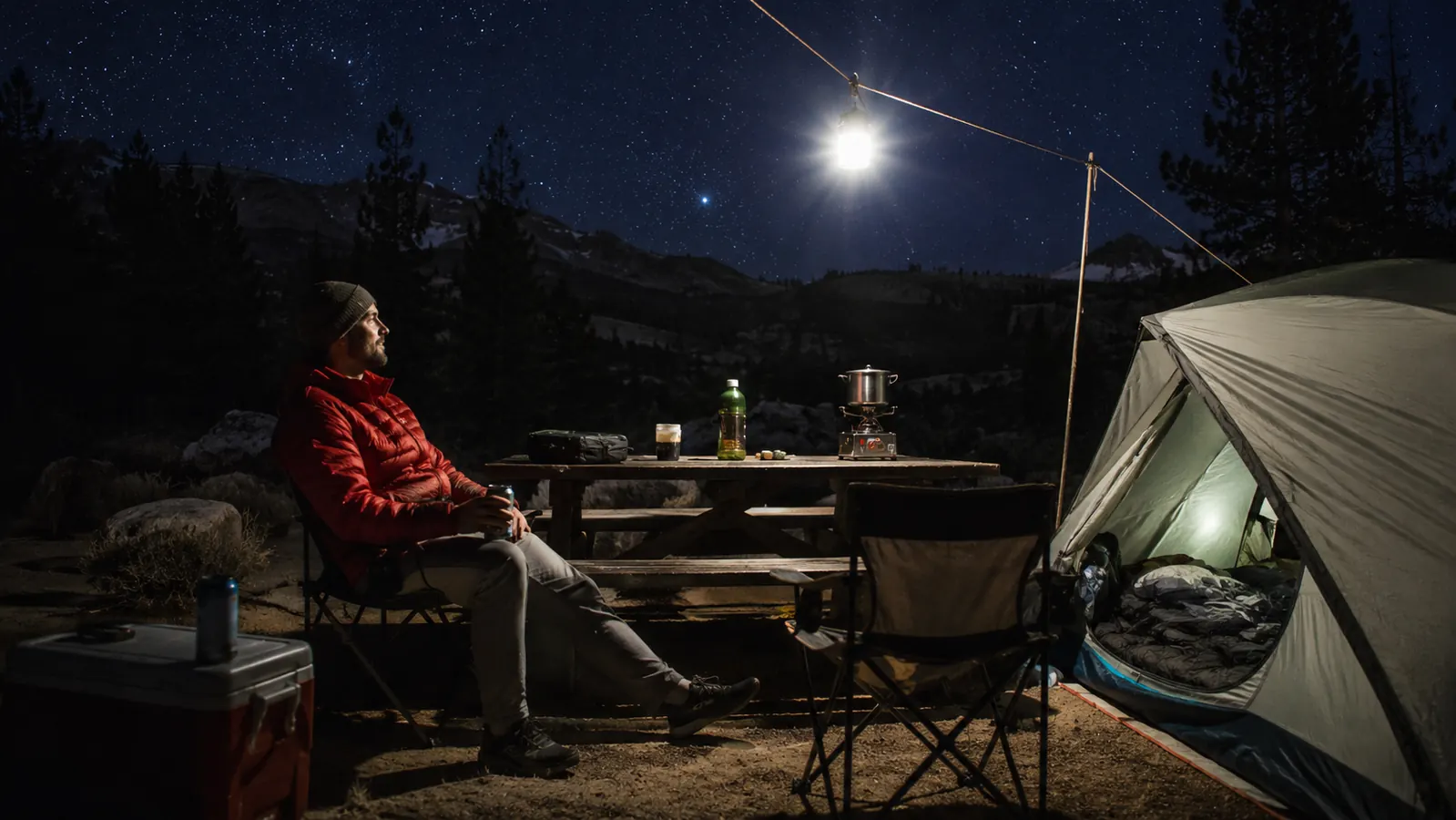
It also works well as a tent light, hanging from the ridgeline and spreading diffused light across a four-person tent interior. The frosted plastic diffuser does its job. No harsh spots, no shadows, just even warm light. For car camping where weight isn't the primary concern, this is exactly the kind of versatile light source that replaces two or three single-purpose items.
Who Should Skip It
If you need a lantern that can run through a full eight-hour night on a single charge at high output, this isn't it. Look at larger-capacity lanterns like the Goal Zero Lighthouse or the BioLite SiteLight, which use bigger batteries and can sustain high brightness longer. If you do a lot of cold-weather camping and rely on a single lantern as your only light source, the cold-weather battery hit matters more. And if you're a backpacker counting grams, this lantern's plastic build and relatively heavy 4400mAh battery make it a car-camping tool, not a trail-weight solution.
The Favourlite also isn't the right fit if you're planning a dispersed multi-day trip with no way to recharge. In that scenario, you need either a bigger battery bank to charge from or a solar-compatible lantern with its own panel. The Favourlite has no solar input. You need a power source to refuel it. That's an important constraint for off-grid setups and backcountry basecamp trips where a car outlet isn't nearby.
How It Stacks Up Against Other Options
If you want a direct comparison between the Favourlite and a premium option, I've put together a side-by-side breakdown in the Favourlite vs. Black Diamond Moji Lantern comparison. The short version is that the Black Diamond costs about twice as much and delivers better build quality and more predictable dimming, but the Favourlite wins on battery size and the phone-charging feature. Depending on your priorities, either could be the right call.
If your main concern is lighting a campsite when fires are banned, a rechargeable lantern like this pairs well with a couple of smaller task lights or headlamps. I've got a full lighting setup guide in the how to light your campsite without a fire article, which covers how to layer light sources so you're never stuck squinting at your dinner in the dark.
The Bottom Line
The Favourlite is a budget lantern that performs like a mid-range lantern in ideal conditions and like a basic lantern when you push its edges. The edges are: max brightness held for more than two hours, recharging in the field without a power source, heavy use in cold weather, and needing a low-battery startup mode. Know those edges and you won't be disappointed. Ignore them and you'll end up eating dinner by headlamp while your lantern blinks out.
For most weekend campers who charge their gear before leaving the house, this hits the right balance of brightness, portability, and price. It's the first lantern I'd recommend to someone new to camping who doesn't want to spend more on a light they might only use six weekends a year. Just charge it before you go. That part is on you.
Ready to pick one up? Check what it's going for today before the price moves.
The Favourlite 3000LM Rechargeable Camping Lantern consistently lands at the budget end and ships Prime. Best value in its category if you go in with the right expectations.
Amazon Check Today's Price on Amazon →